

Neck Pain: Causes, Treatment & Chiropractic Care in Manasquan, NJ
Neck pain is one of the most common spinal problems I see in my Manasquan office. It can develop gradually from posture, computer and phone use, repetitive activities, or sleeping position, or it can appear suddenly after a car accident, fall, sports injury, or other trauma.
Our practice has been treating spinal conditions since 1965, and I have been practicing chiropractic since 2000. During that time, I have personally evaluated and treated thousands of patients with neck and back problems.
As a chiropractic physician focused on spinal conditions, I evaluate the cervical spine to determine what may be causing your symptoms and which treatment approach is appropriate. Chiropractic care is a primary conservative treatment option for many mechanical causes of neck pain.
The first step is understanding what is actually causing the problem.
What Causes Neck Pain?
The cervical spine consists of seven vertebrae, intervertebral discs, small spinal joints, muscles, ligaments, and nerves. These structures work together to support your head and allow your neck to move. Problems involving any of them can contribute to pain or restricted movement.
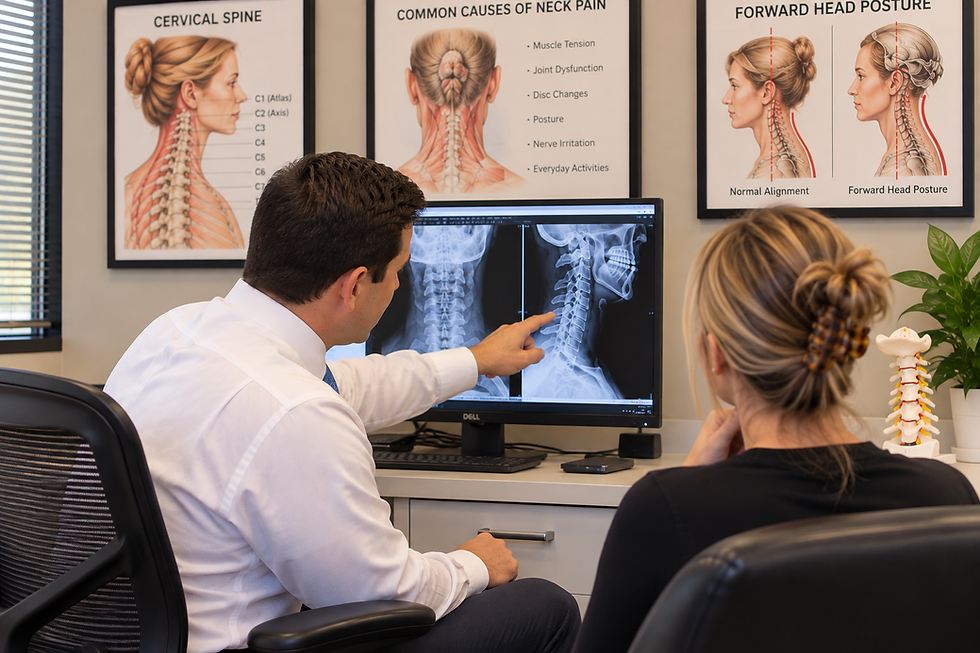
Common causes include:
Restricted spinal joints that reduce normal movement.
Muscle tension or strain involving the neck and upper shoulders.
Poor posture and forward head positioning.
Cervical disc bulges or herniations.
Arthritis and degenerative changes.
Nerve irritation or compression.
Sports injuries and falls.
Motor vehicle accidents and whiplash.
Repetitive occupational or recreational activities.
Neck pain can also be accompanied by headaches, shoulder pain, arm symptoms, numbness, or tingling. The pattern of symptoms can provide important clues about what structures may be involved.
How Everyday Activities Can Contribute to Neck Pain
Computer Use and "Tech Neck"
Spending hours at a computer can place prolonged demands on the cervical spine, particularly when the head remains forward relative to the shoulders. When the head moves forward, the muscles at the back of the neck must work harder to support it. Over time, this can contribute to fatigue, stiffness, and discomfort. A monitor that is too low, prolonged sitting, and inadequate movement breaks can all contribute.
Looking Down at Your Phone
The problem with phone use isn't simply that you look down. It is how long you remain in that position.
Holding your head forward while texting, reading, or scrolling for extended periods can contribute to neck and upper shoulder tension. Raising the phone closer to eye level and changing positions frequently can reduce prolonged stress on the cervical region.
Sleeping Position
A pillow that is too high or too low can hold the neck in an uncomfortable position for hours. Stomach sleeping also requires the head to remain rotated for prolonged periods. If you regularly wake with neck pain or stiffness, your sleeping position may be contributing to the problem.
Driving
Long periods behind the wheel can produce neck and upper-back stiffness, particularly when the head remains in one position for extended periods. Proper seat positioning and taking movement breaks during long trips can help.
Work and Repetitive Activities
Lifting, overhead work, sports, prolonged looking down, and repetitive movements can all place additional stress on the cervical spine. Sometimes the problem isn't one particular movement, but the accumulation of repeated stress over time.
Loss of Cervical Lordosis and Forward Head Posture
The normal cervical spine has a gentle forward curve called cervical lordosis. Sometimes an X-ray report describes a straightening or loss of the normal cervical curve. This can occur for several reasons, including positioning during the X-ray, muscle guarding, posture, and degenerative changes.

A straightened cervical curve does not automatically mean it is the cause of someone's pain. It needs to be considered along with the patient's symptoms and examination findings.
Forward Head Posture
Forward head posture occurs when the head sits farther forward in relation to the shoulders.
This can increase the workload on the muscles supporting the head and may contribute to:
Muscle fatigue.
Reduced comfort during prolonged sitting.
Tightness around the base of the skull.
Certain types of neck-related headaches.
The muscles and connective tissues around the upper cervical spine and base of the skull can contribute to cervicogenic or tension-type headaches when they become irritated or excessively tight.
Cervical Kyphosis and the "Hump" at the Base of the Neck
Some people notice a prominent area where the neck meets the upper back, around the C7-T1 region. Several factors can contribute to this appearance, including body composition, posture, spinal curvature, and changes involving the vertebrae.
In some patients, cervical kyphosis, an abnormal backward curvature of the cervical spine, can alter the normal mechanical loading of the neck. However, a visible prominence does not automatically mean someone has cervical kyphosis. A proper examination and, when indicated, imaging are needed to determine what is actually occurring.
Neck Pain After a Car Accident: Understanding Whiplash
Whiplash commonly occurs during motor vehicle collisions when the head and neck undergo rapid acceleration and deceleration. The resulting forces can affect muscles, ligaments, joints, discs, and other cervical structures. Similar hyperextension and hyperflexion forces can also occur during sports injuries, falls, and other accidents.
Symptoms of Whiplash
Symptoms may appear immediately or develop hours or days later and can include:
Neck pain and stiffness.
Reduced range of motion.
Muscle spasms.
Shoulder or upper-back pain.
Headaches.
Tenderness.
Pain, numbness, or tingling extending into an arm.
After an injury, muscles may tighten and movement may become restricted. Some patients subsequently develop compensatory movement and postural patterns. One pattern sometimes seen with prolonged postural dysfunction is upper crossed syndrome, involving characteristic imbalances among the neck, shoulder, and upper-back muscles. It is not an inevitable result of whiplash, but it can occur in some patients.
When Should Neck Pain Be Evaluated?
Not every episode of neck stiffness requires treatment. However, an evaluation is appropriate when symptoms persist, repeatedly return, interfere with daily activities, or follow an injury.
You should consider an evaluation if you have:
Persistent neck pain or stiffness.
Difficulty turning your head.
Recurring neck-related headaches.
Pain extending into the shoulder or arm.
Numbness or tingling.
Symptoms following a car accident, fall, or sports injury.
Severe neck pain following significant trauma, progressive weakness or numbness, or symptoms such as difficulty speaking, facial drooping, sudden severe headache, or loss of coordination require prompt medical evaluation.
How I Evaluate Neck Pain
Treatment begins with determining what may be producing the symptoms.
I evaluate the patient's history, cervical range of motion, spinal and muscular findings, and neurological status when appropriate.
My diagnostic experience also includes spinal imaging. I am qualified to take and interpret spinal X-rays and certified in reading spinal MRI studies.
X-rays: to determine if neck pain treatment in Manasquan NJ is right for you
X-rays can provide information about:
Bone structure.
Spinal alignment.
Degenerative changes.
Certain injuries.
Changes in the cervical curve.
MRI:
MRI provides different information and is particularly useful when evaluating:
Intervertebral discs.
Nerve roots.
The spinal cord.
Other soft tissues.
Imaging isn't necessary for every case of neck pain. When it is indicated, the images should be interpreted together with the patient's symptoms and physical examination.
Chiropractic Treatment for Neck Pain

Chiropractic care is a primary conservative treatment option for many mechanical causes of neck pain.
Treatment is designed to address restricted joint movement, muscular dysfunction, postural problems, and other contributing factors. The technique selected depends heavily on the individual patient, the underlying cause of the condition, and any hindering factors such as osteoporosis, atherosclerosis, and spinal degeneration.
Chiropractic Techniques
Depending on your condition and comfort level, I may use several different approaches:
Diversified manual adjustment — A hands-on technique using a controlled, specific movement to improve motion in a restricted spinal joint.
Activator — A small handheld instrument that delivers a quick, gentle impulse to a specific area of the spine. It allows precise treatment without the twisting or popping associated with some manual techniques.
Drop-table technique — Uses a specially designed chiropractic table that gently moves downward as the adjustment is delivered. This reduces the amount of force needed and can be useful for certain patients.
Toggle-recoil — A precise, low-amplitude hands-on technique using a quick thrust followed by an immediate release. It is commonly used to address specific areas of spinal restriction.
ArthroStim — A handheld instrument that delivers controlled, repeated impulses to the spine. It can be used to mobilize restricted areas without a traditional manual thrust.
Soft-tissue techniques — Hands-on treatment directed at tight, tender, or overworked muscles and other soft tissues around the neck and shoulders.
Therapeutic exercises — Specific exercises designed to improve neck and upper-back strength, mobility, endurance, and postural control.
Physiotherapy modalities — Therapeutic treatments used within my chiropractic scope of practice to help reduce pain, muscle tension, and inflammation and support recovery.

There is no single technique that is appropriate for every patient. Some patients respond well to traditional manual adjustment, while others may be better suited to instrument-assisted or lower-force approaches. Exercises may also be incorporated to improve mobility, strength, endurance, or postural control. The objective is to address the factors contributing to the patient's symptoms and improve function.
What About Herniated Discs and Pinched Nerves?
Neck pain that travels into the shoulder, arm, or hand can sometimes involve irritation of a cervical nerve root. Possible causes include a herniated disc, degenerative changes, or narrowing around the nerve. Importantly, not every disc abnormality seen on an MRI is responsible for pain, and arm symptoms do not automatically mean that surgery is necessary.
The patient's symptoms, examination, and imaging findings need to be considered together when determining an appropriate course of conservative care or whether additional medical evaluation is warranted.
Chiropractic Care: A Conservative Treatment Option
When treating many common causes of neck pain, conservative care is an important place to start. Chiropractic treatment can address restricted joint movement, muscular tension, and mechanical dysfunction without immediately resorting to injections or surgery.
Research supports manual therapy, including spinal manipulation or mobilization, combined with exercise for many patients with neck pain. PubMed
Unlike injections and surgery, chiropractic adjustments do not involve needles, anesthesia, or surgical incisions. Cervical epidural steroid injections carry their own risks, including serious neurological complications, while surgery involves procedural risks and recovery. U.S. Food and Drug Administration
As a chiropractic physician, my goal is to identify the source of your neck pain and determine whether conservative chiropractic treatment is appropriate. Depending on your condition, care may include manual adjustments, instrument-assisted techniques, soft-tissue treatment, and therapeutic exercises.
Proper evaluation and patient selection are important. A chiropractic physician is trained to evaluate spinal conditions, recognize warning signs, explain appropriate treatment options, and determine when cervical manipulation is appropriate. Patients should choose a specialist based on education, specialized training, clinical experience, and the ability to properly evaluate the condition, not fear or misconceptions about chiropractic care.
Chiropractic care is not the right fit for every patient or every condition. When appropriate, acupuncture and massage therapy are also available in our office and may be used as alternatives or in conjunction with chiropractic care. Combining these approaches can be particularly helpful when muscle tension, soft-tissue restrictions, or other factors are contributing to neck pain.
Why Choose a Chiropractic Physician for Neck Pain?
Neck pain treatment in Manasquan NJ: Choosing a provider for neck pain means looking beyond a professional title to their spinal training, diagnostic experience, and clinical expertise. My education and clinical practice have focused heavily on the spine. I have been treating spinal conditions since 2000 and have evaluated thousands of patients with neck and back problems.
My training includes spinal examination, diagnosis, manual and instrument-assisted adjusting, physiotherapy, therapeutic exercise, and spinal imaging. When you come to my office for neck pain, the goal isn't simply to give you an adjustment. The goal is to understand the problem and determine the most appropriate way to treat it.
For many patients with mechanical neck pain, chiropractic care provides a conservative approach that can address both symptoms and the underlying mechanical factors contributing to them.
Neck Pain Treatment in Manasquan NJ
Stiso Chiropractic, Acupuncture & Massage Therapy has served the community since 1965.
I treat patients from Manasquan, Wall Township, Brielle, Sea Girt, Point Pleasant, Belmar, and surrounding Monmouth and Ocean County communities.
If you're experiencing persistent neck pain, stiffness, headaches associated with your neck, or symptoms following an injury, an evaluation can help determine what is causing the problem and whether chiropractic care is appropriate.
1903 Atlantic Avenue
Manasquan, NJ 08736